
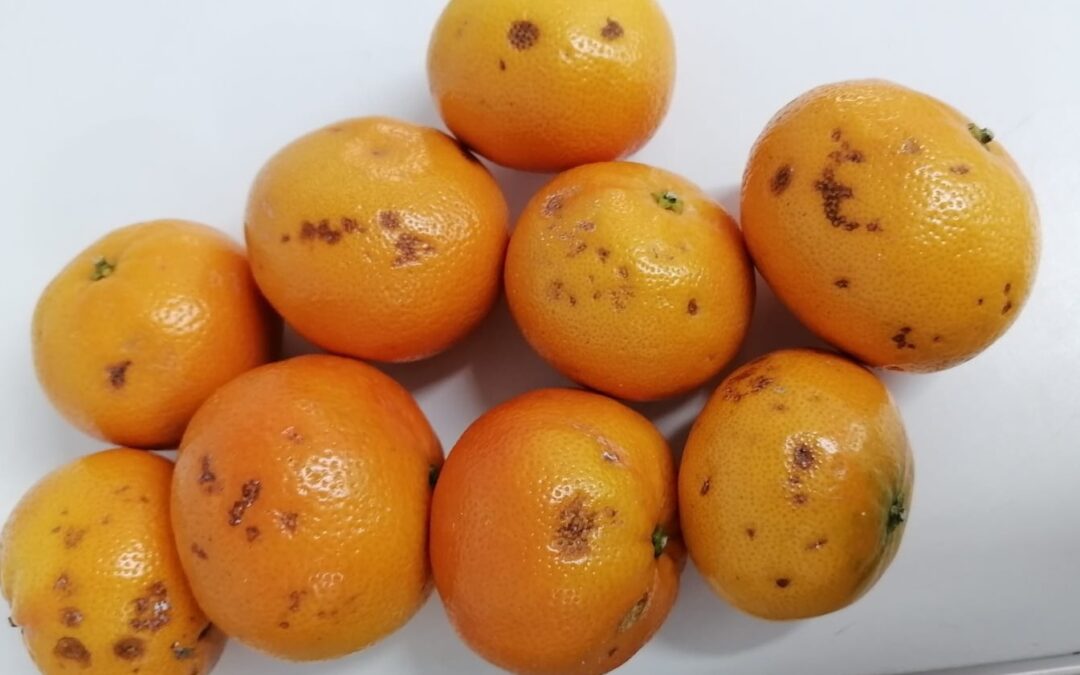
When it comes to citrus quality, what’s on the outside often matters just as much as what’s on the inside. Even fruit with excellent internal quality can be downgraded or rejected if rind blemishes affect its appearance, making rind condition one of the most important factors influencing pack-outs and export returns.
Rind disorders are rarely caused by a single factor. Instead, they result from a complex interaction between fruit physiology, orchard management practices, environmental conditions, and post-harvest handling. Among these influences, mineral nutrition plays a fundamental role in determining how well the rind can withstand physical and physiological stress throughout the season.
A resilient rind starts with balanced nutrition. Calcium strengthens cell walls and membranes, potassium and magnesium support water regulation within cells, and boron helps maintain cell wall structure through pectin cross-linking. Understanding how these nutrients work together – and monitoring key ratios such as calcium to potassium in leaf analyses – can help growers build stronger, healthier fruit that is better equipped to reach the market in premium condition.
This is how the different nutrients add value to your crop:
- Calcium (Ca): Strengthens cell walls and stabilises membranes; efficiency increases rind breakdown and pitting
- Potassium (K): Regulates osmotic balance and sugar transport; excess K can suppress Ca uptake, promoting soft rinds
- Magnesium (Mg): Supports chlorophyll and lipid stability; a deficiency accelerates senescence
- Nitrogen (N): Drives growth; over-application leads to softer, watery rind tissue and a higher susceptibility to physiological disorders
- Boron (B): Essential for cell wall cross-linking via RG-II; a deficiency causes cracking and poor elasticity
- Silicon (Si): Can increase rind toughness and reduce mechanical injury in some fruits; evidence is emerging and cultivar specific.
Integrating orchard management and post-harvest handling
- Calcium programme: Apply soil Ca (e.g. gypsum, calcium nitrate) early and regularly; avoid large single applications
- Nitrogen management: Use moderate rates; select nitrate-based sources; avoid late or excessive dressings
- Potassium: Maintain within target levels and monitor the Ca:K ratio; avoid overuse of KCl on sandy soils
- Boron: Apply foliar B at petal fall and pre-colour break, especially on low-organic soils
- Irrigation: Maintain steady soil moisture using sensor feedback rather than a fixed schedule
- Pre-harvest irrigation: Use a mild deficit before harvest to lower turgor where appropriate; avoid harvesting after heavy rain or irrigation
Remember, the foundation of post-harvest quality is built in the orchard.
Read the full article on rind disorders in Issue 8 of our ROOTED e-mag: https://duroinursery.co.za/media/


